Clearing an Overgrown Lot in Horry County, SC: Rules, Permits, and What It Takes
For most overgrown lots in Horry County, cutting the vegetation itself does not trigger a county permit. What does trigger permits is disturbing soil, and separate rules cover burning debris and working on wetlands. Confirm your own parcel with the county before work starts, because site conditions change the answer.
Do you need a permit to clear brush in Horry County?
The county permit that applies to this kind of work is keyed to land disturbance. It is not keyed to cutting plants. The Horry County Stormwater Department requires a stormwater permit when 0.5 acre or more of area will be disturbed.
The county defines land disturbance as any use of land that changes its physical characteristics or topography. The change has to be one that may cause erosion and alter stormwater runoff. That definition points at dirt work such as grading and excavation.
The county also names exemptions from that permit. Single family residential construction, agricultural land uses, timbering activity, and minor residential subdivisions are listed as exempt.
Mulching growth in place leaves the soil and the root mat where they are. We move no dirt, so land disturbance permits are the excavator’s side of the job. Call the Horry County Stormwater Department about your parcel, since the county makes that call.
What triggers a county letter about an overgrown lot?
Horry County addresses this in Chapter 10 of the county code, on garbage, trash, and refuse. The code says an owner may not let property serve as a collecting place for debris, trash, or litter. It also bars property from becoming a breeding place for mosquitoes or a refuge for rats and snakes. A fire hazard counts as well.
The same code tells owners to keep drainage ditches, ponds, and pipes clear. Litter, debris, weeds, and brush that block the flow of water are named directly.
The Horry County Department of Environmental Services has primary responsibility for enforcing that chapter. County personnel may issue a uniform citation to cease and desist once a violation is confirmed. County complaints generally go in through a 311 service request.
We could not find a published grass height number in the county code. If you heard that a specific height triggers a letter, verify it with the county.
These county rules apply in unincorporated Horry County. Inside a city or town, that municipality runs its own code, so check with city hall.
What are the burning rules, and why does mulching skip them?
South Carolina law requires you to notify the South Carolina Forestry Commission before burning outdoors. The Commission states this plainly for debris burns, prescribed burns, and land-clearing burns. The notification requirement applies outside city and town limits.
You can notify the Commission through its website or by a county phone line. The Commission also sets conditions on the burn itself. Limit the fire to vegetative material such as leaves, limbs, and branches. Clear a firebreak around the site.
Keep equipment on hand to hold the fire under control, and stay with it until it is completely safe. The Commission notes that local ordinances may apply on top of state law.
Some fires are exempt from notification. Grills, chimineas, portable outdoor fireplaces, and permanent fire pits built of noncombustible material fall outside the rule.
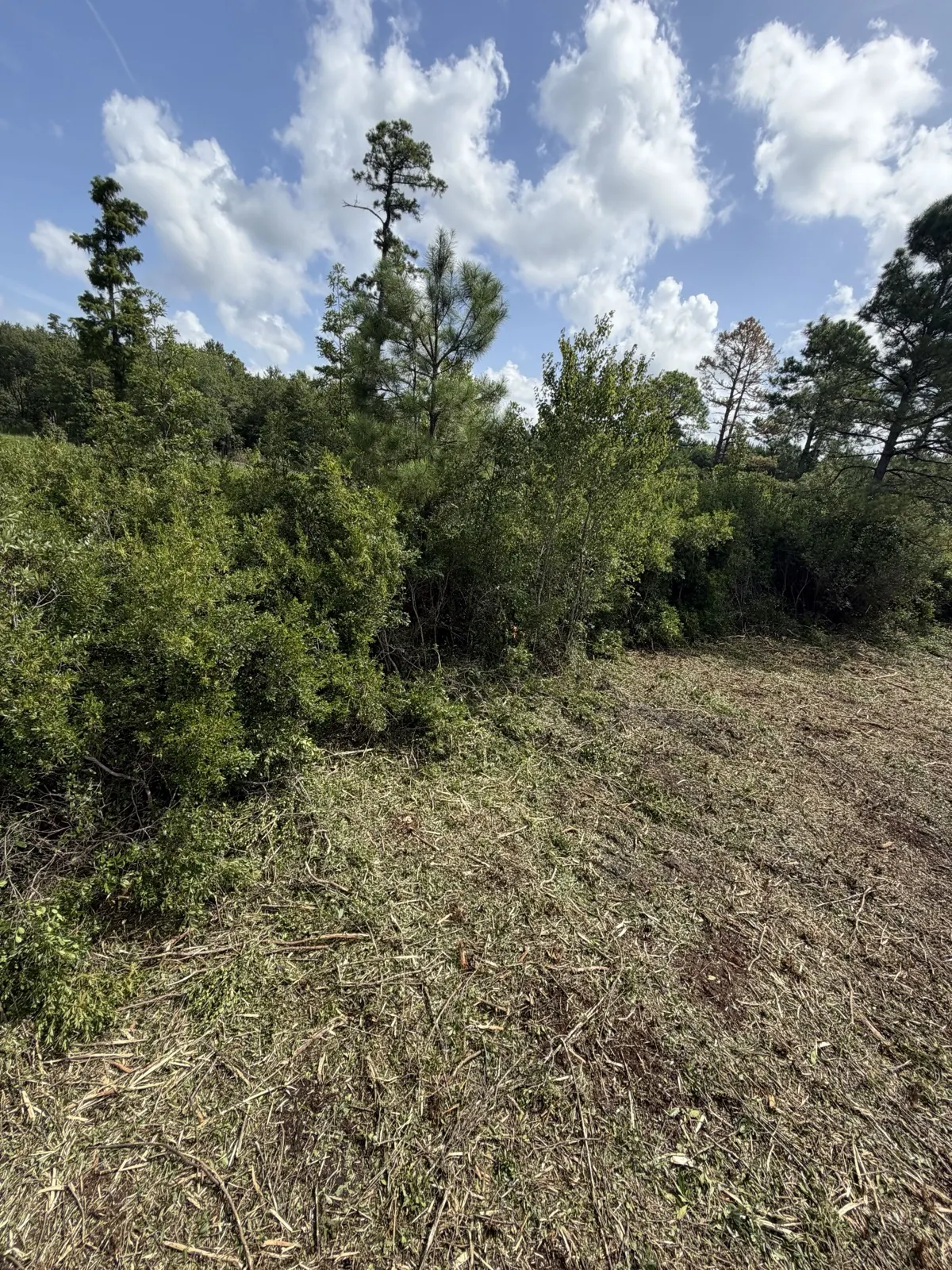
Here our method changes the math. A forestry mulcher grinds standing growth into chips that drop where the machine works. No burn pile forms, so there is nothing to notify about. There is also no debris to truck off, which takes dump fees and hauling out of the job.
What about wetlands and low ground?
Much of Horry County sits low and flat, and plenty of parcels hold water. Federal rules can reach vegetation work on that kind of ground.
The U.S. Army Corps of Engineers regulates discharges into wetlands that are waters of the United States. That authority comes from Section 404 of the Clean Water Act. Mechanized land clearing is named in that framework. Equipment fitted with shear blades or rakes can create a regulated discharge when soil is redeposited.
South Carolina adds a state layer through SC DES. A project needing a federal permit also needs a Section 401 water quality certification. Horry County is one of South Carolina’s eight coastal counties, so coastal zone consistency review can apply as well.
We are contractors, not wetland consultants. If your lot holds standing water, get a delineation before any machine runs. Start with the Army Corps of Engineers and SC DES.
What do HOA rules cover?
If your lot sits in a subdivision, private rules can matter more than county rules. Covenants are recorded, run with the deed, and bind the owner.
South Carolina governs these under the South Carolina Homeowners Association Act at Section 27-30-110 and following. Many communities run an architectural review committee that reviews exterior changes. Landscaping often falls under that review.
The Act requires an association to maintain a written fine schedule. It also requires at least 15 days of notice before a fine is imposed.
Read your covenants before you schedule work. Some communities restrict tree removal or set buffers along lot lines. Ask your HOA in writing and keep the reply.
What does clearing an overgrown lot involve?
Most overgrown lots here carry a similar mix. Vines, briars, saplings, and privet fill the space under whatever mature trees are left standing.
Our lot clearing work runs a Bobcat T300 track loader with a forestry mulcher head. The head grinds standing growth into chips on the spot. Those chips stay put as a mulch layer over the ground.
The machine handles brush and small trees well. Larger stems and heavy timber slow it down and raise the cost. Stumps get cut to grade or a bit below, and the roots stay in the soil.
Thinner growth falls under brush clearing, where a pass goes faster. We do not offer stump grinding, tree removal, excavation, grading, dirt work, hauling, or burning. When a job crosses into that work, we say so.
How do you get a lot priced?
Price tracks how thick the growth is, how large the stems are, and how the ground sits. Wet ground and tight access slow the machine. Acreage by itself does not tell the story.
Send us the property address or the parcel number to start. Aerial images and county parcel data show boundaries and rough cover. A short site visit confirms stem size and access.
Category 5 Land Management handles land clearing in Longs, SC and across Horry County. Free estimates. Call (843) 385-1090.