Do You Need a Burn Permit in South Carolina?
South Carolina has no statewide burn permit. Outside city and town limits, state law requires you to notify the South Carolina Forestry Commission before you burn. Inside a town, the town sets the rules, and some towns ban outdoor burning. A burning ban stops outdoor burning until it lifts.
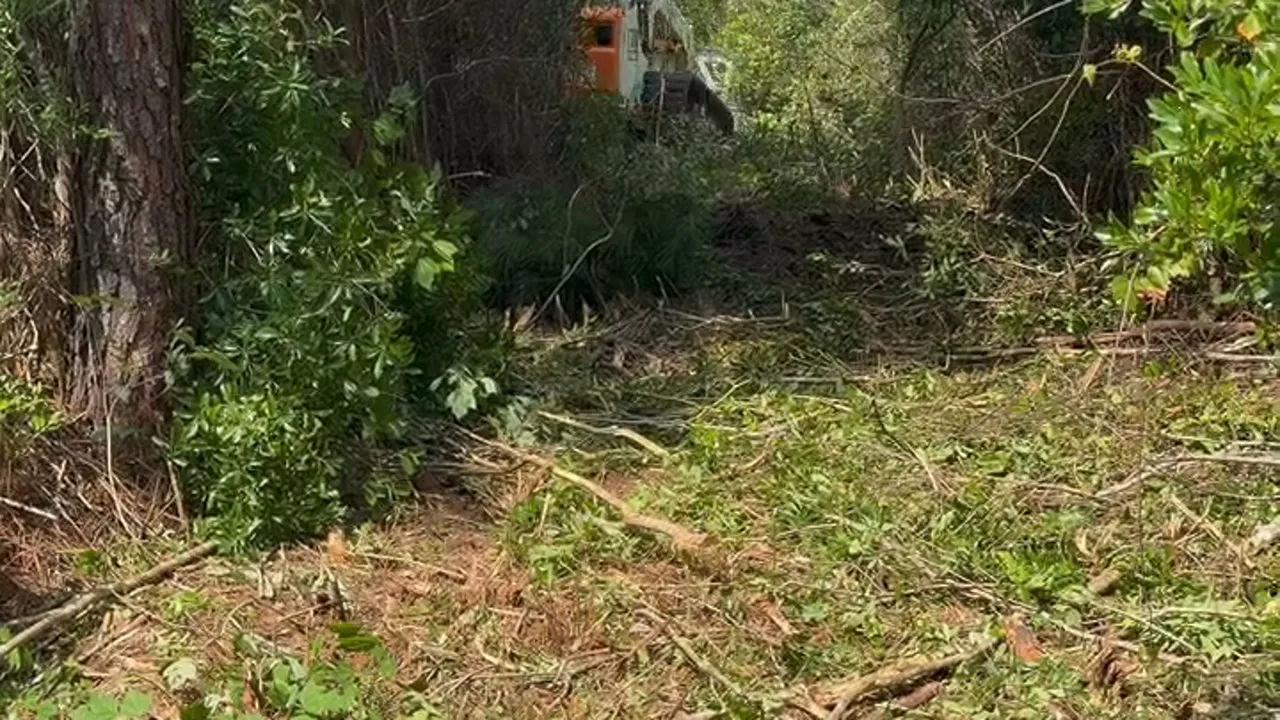
Every burn also depends on the weather and the county’s rules. Brush that never goes into a pile never needs a burn. Brush clearing with a forestry mulcher grinds brush and saplings into chips where they stand, so no burn pile forms.
How do you notify the Forestry Commission before you burn?
State law covers fires in or next to woodlands, brushlands, grasslands, ditchbanks or hedgerows. Before you light one, you notify the State Forester. That rule applies only in unincorporated areas, outside city and town limits. The person who starts the fire must watch it and have it under control before leaving.
The Forestry Commission takes three kinds of notifications: residential yard debris, prescribed and land clearing or construction burns. A yard debris burn can go through the online form at scfc.gov/notify. It asks for your county, address, name and contact information.
You can also call your county’s toll-free line and leave your name, number and address after the beep. In Horry County that line is 1-800-986-5404, and in Georgetown County it is 1-800-986-5256. Land clearing and construction burns are called in on your county’s toll-free number. Prescribed burns for forestry, wildlife or farming go to a dispatcher at (800) 777-3473.
| Burn type | Who you notify and how | The main conditions |
|---|---|---|
| Yard debris from your home | Forestry Commission, online form or county toll-free line | Leaves, limbs and branches from your own yard, a cleared firebreak, and you stay until the fire is completely safe |
| Land clearing | Forestry Commission, county toll-free line | Not a mostly residential area, 1,000 feet from public roads and off-site homes and businesses, started between 9 a.m. and 3 p.m. |
| Prescribed (forestry, wildlife, farm) | Forestry Commission dispatcher at (800) 777-3473 | Called in by phone, since the online form does not take prescribed burns |
| Home construction (houses and duplexes) | Forestry Commission, county toll-free line | No burning from April 1 to October 30 |
Breaking the notification law can be charged as a misdemeanor under Section 48-35-60. A first offense can bring a fine of up to $200 or up to 30 days in jail. A second offense within ten years can bring a fine of at least $500, up to 60 days, or both.
What can you burn, and what has to stay off the pile?
State rules prohibit open burning except for a list of exceptions. One covers leaves, tree branches and yard trimmings from a private home, burned on that same property. The Forestry Commission’s rule for yard debris is vegetative material only, like leaves, limbs and branches.
Household waste stays off the pile. Horry County’s list includes treated wood, cardboard, paper, shingles, siding, wire, tires, insulation, plastic and oil. Burning garbage in a burn barrel is illegal, and so is burning waste from commercial construction sites.
The fire has its own rules. Clear a firebreak around the burn site and keep the right equipment on hand to control it. Stay with the fire until it is completely safe. Wind can carry embers more than a mile.
Cooking fires, chimineas, portable outdoor fireplaces and permanent fire pits fall outside the notification law. The ground around them still has to be cleared, with equipment on hand to control the fire.
What are Horry County’s burning rules?
Unincorporated Horry County follows Chapter 20, Article IX, Section 20-451 of the county code. Horry County Fire Rescue posts those rules on its open burning page. You still notify the Forestry Commission first, at 1-800-986-5404 or online.
The fire must sit at least 50 feet from any structure and 50 feet from any other property line. Whoever owns the land must authorize any burning on it. State law says renters and anyone else need that permission first. While a Horry County burning ban is on, no open burning is permitted.
The county page also lists the land clearing burn conditions from the state regulation. Construction burns are allowed only on house and duplex building sites, and never from April 1 to October 30. Breaking the rules can bring an ordinance summons or a fine.
Some cleanups start with a county letter. If yours did, read what sets off an overgrown lot letter before you plan a burn.
Can you burn land clearing debris on a neighborhood lot?
The state’s environmental agency, SCDES, sets the land clearing rules in Regulation 61-62.2. A land clearing burn is allowed only in an area that is not mostly residential. The fire must sit at least 1,000 feet from public roads. It must also sit 1,000 feet from homes, businesses and industry that are not part of the property.
Everything burned has to come from that same site. Burning starts only between 9 a.m. and 3 p.m., and nothing goes on the fire between 3 p.m. and 9 a.m. the next morning.
No more than two piles of 30 by 30 feet can burn within a six-acre area at once. Salvageable timber and pulpwood have to come out first. Forestry Commission dispatchers do not interpret the regulation, so site questions go to SCDES.
Those conditions are hard to meet on a lot inside a neighborhood. Other houses usually sit well inside 1,000 feet, and the area around the lot is mostly homes. Grinding a homesite’s brush and saplings into chips leaves nothing to pile or light.
Clearing the land raises its own permit questions about stormwater, trees and wetlands. Our guide to the separate permits for clearing land covers those.
What changes inside city or town limits?
The state notification law does not apply inside the corporate limits of a town or city. Neither statewide burning ban applies there either. Inside a town, the town’s ordinances govern, and city or county officers enforce them.
Some South Carolina towns have banned outdoor burning altogether, and others limit it by ordinance. SCDES says to always check with your local government before you burn anything outdoors.
North Myrtle Beach is one example of a town with its own terms. Its published open burning guidelines cover burning tree and vegetation debris on parcels of 20 acres or more, cleared for a roadbed, its right-of-way or development of the property. The city manager or a designee must inspect and approve the site first. The burn then happens in a forced air curtain burn pit or another approved method that controls smoke.
Myrtle Beach, Conway and the other towns set their own rules, so call the town before you plan a burn. A burn that meets state rules still does not excuse you from local ordinances or from damage the fire causes.
How do burn bans work in South Carolina?
A burning ban legally prohibits outdoor burning. Bans are emergency measures, declared only when outdoor burning is a significant threat to public safety. Several notices sound alike, and only some of them stop a burn.
| Notice | Who issues it | What it means for your burn |
|---|---|---|
| State Forester’s Burning Ban | Director of the Forestry Commission | Generally read to cover all outdoor burning, including campfires |
| Governor’s Burning Ban | The governor, on the State Forester’s recommendation | Less restrictive, with allowances for certain agricultural burning |
| Red Flag Fire Alert | Forestry Commission | No ban by itself, but the Commission asks you to postpone |
| Red Flag Warning | National Weather Service | A weather warning, separate from the Commission’s alert |
| Horry County burning ban | Horry County | No open burning permitted |
The State Forester’s ban covers fires in or next to woodlands, brushlands, grasslands, ditchbanks or hedgerows. That is generally read to include all outdoor burning. A 2017 law added campfires and other recreational fires to what it can stop.
A Red Flag Fire Alert is a Forestry Commission wildfire danger warning. It does not prohibit burning when all other state and local rules are followed. The Commission asks people to put off outdoor burning voluntarily. An alert can also trigger county or local ordinances that do restrict fires.
The National Weather Service Red Flag Warning is a separate thing. The weather service watches conditions like relative humidity of 25 percent or less. Sustained winds of 20 mph or more, or gusts of 30 mph or more, count too.
For scale, the Commission’s page counts 29 State Forester’s Burning Bans since 1987. It also counts 74 Red Flag Fire Alerts in the agency’s 90-year history.
One recent statewide ban ended in spring 2026. The Forestry Commission lifted a State Forester’s Burning Ban for all counties at 7 a.m. on Friday, May 1, 2026. The state was still in drought when it lifted.
Breaking a State Forester’s or Governor’s ban carries a fine of up to $200 for a first offense. Second and later offenses bring at least $500. Any burn a ban covers needs a notification first. So not knowing about the ban is not generally a defense.
How do you check for a burn ban before you burn?
Check on the morning you plan to burn, since bans change with the weather. Start with the Forestry Commission’s bans and alerts page. Then start your notification, because the online form only opens when burning is allowed in your county that day.
In unincorporated Horry County, also check Horry County Fire Rescue for a county burning ban. Inside a town, call the town.
Then check the weather. Skip windy days, especially when humidity is at 30 percent or lower. Escaped debris burns are the leading cause of wildfires in South Carolina. They made up nearly 60 percent of the state’s wildfires in fiscal year 2020-21.
How is North Carolina different in Brunswick and Columbus counties?
North Carolina does use a burning permit. Between midnight and 4 p.m., a permit is required for a fire in woodland protected by the NC Forest Service. The rule also reaches fires within 500 feet of that woodland.
The permit is free, online or at a county office. It is a notification rather than a request for permission to burn.
How do you clear brush without burning it?
Grinding brush in place takes burning out of the plan. Our Bobcat T300 compact track loader carries a forestry mulcher head. It grinds brush, saplings and small trees up to roughly 6 to 8 inches across where they stand. The chips stay on the land as ground cover, and stumps stay in the ground.
SCDES itself suggests composting yard debris and using the chippings as mulch. Mulching in place gets to the same end without a fire to report.
Storm debris works the same way. With storm cleanup that leaves the blowdown as chips, downed brush and small trees get ground where they fell. The cost guide shows how haul-off fees compare with mulching in place, using published numbers. Estimates are free and done on site in Horry and Georgetown counties and in Brunswick and Columbus counties.